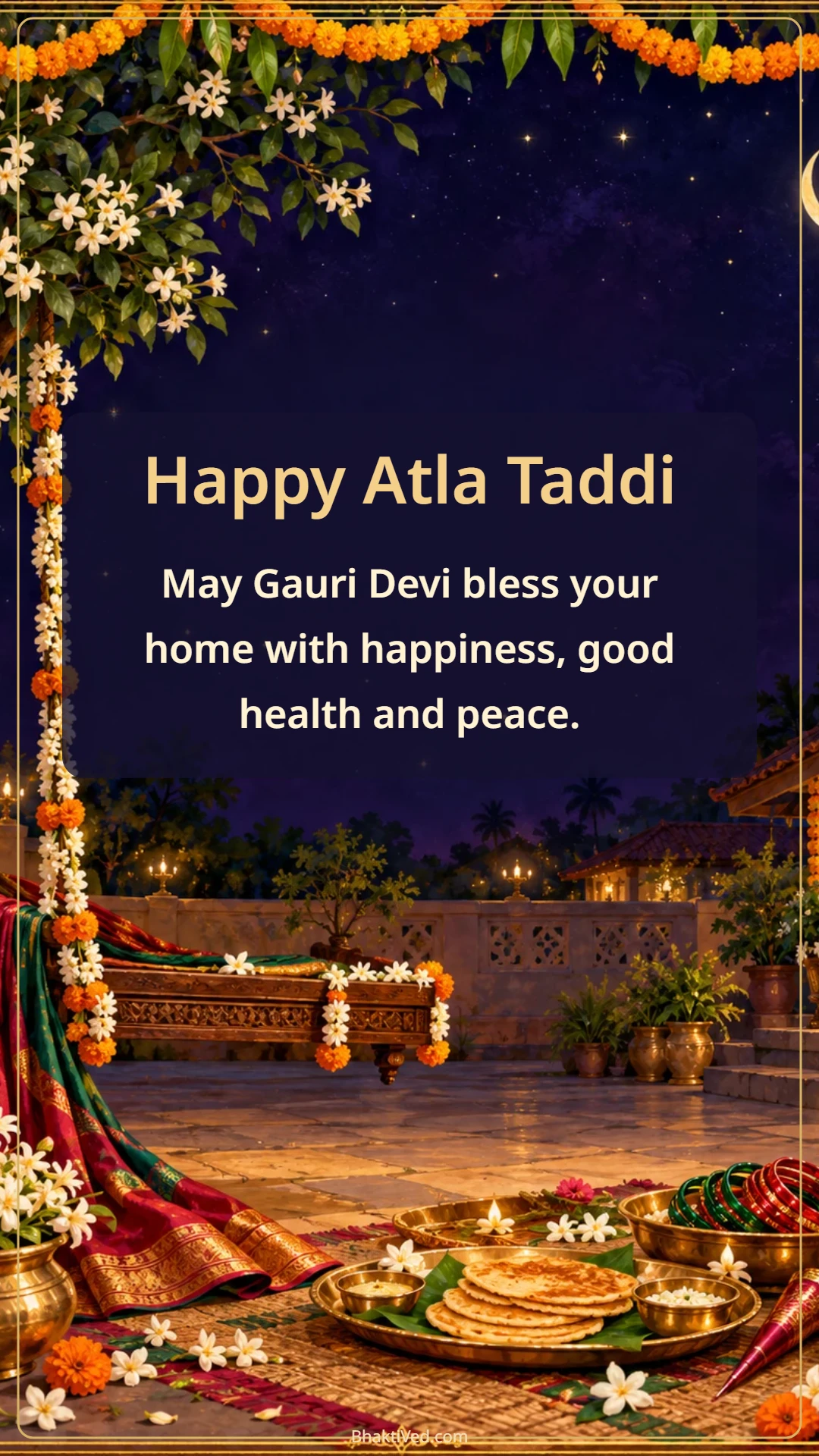
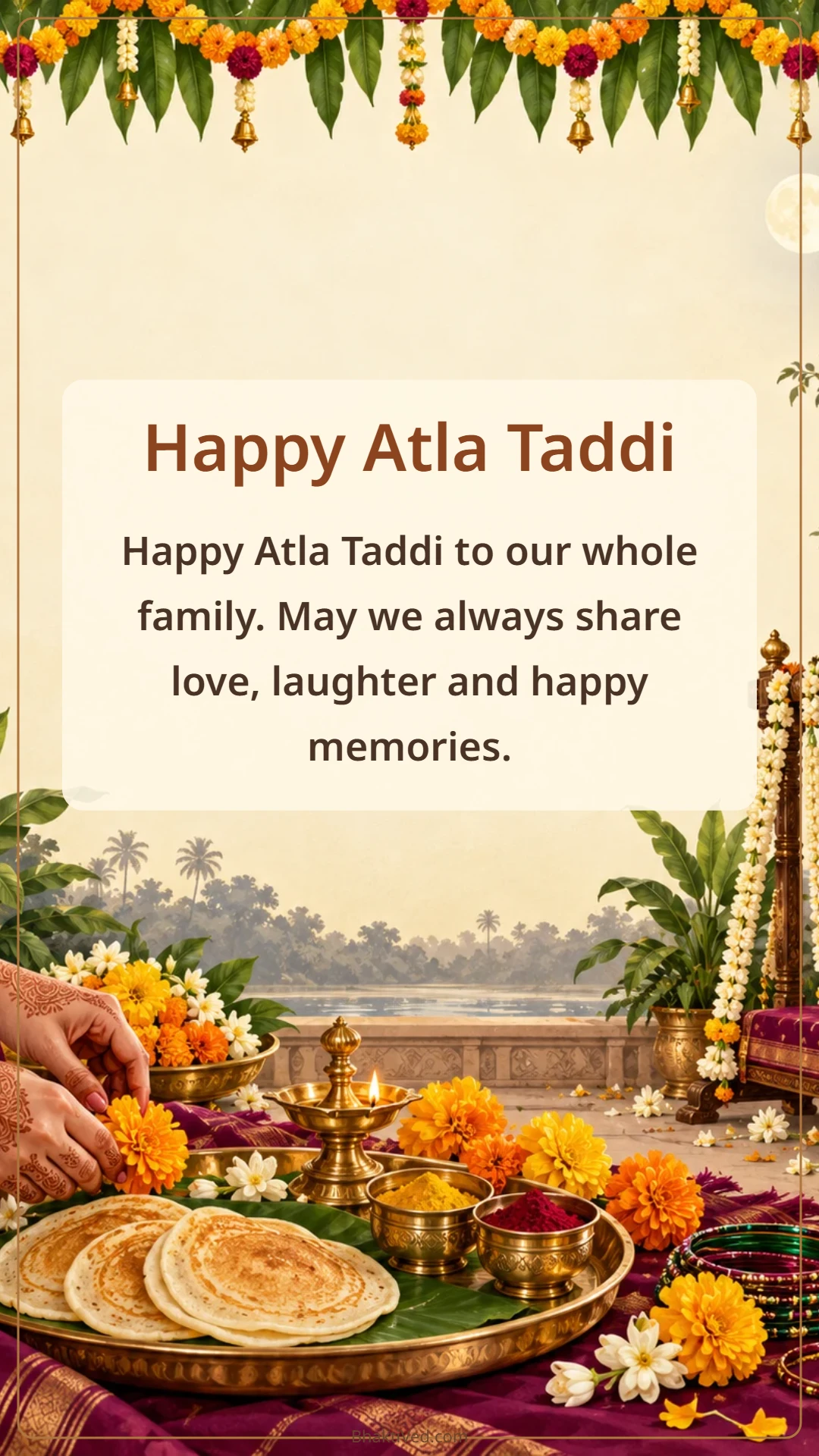
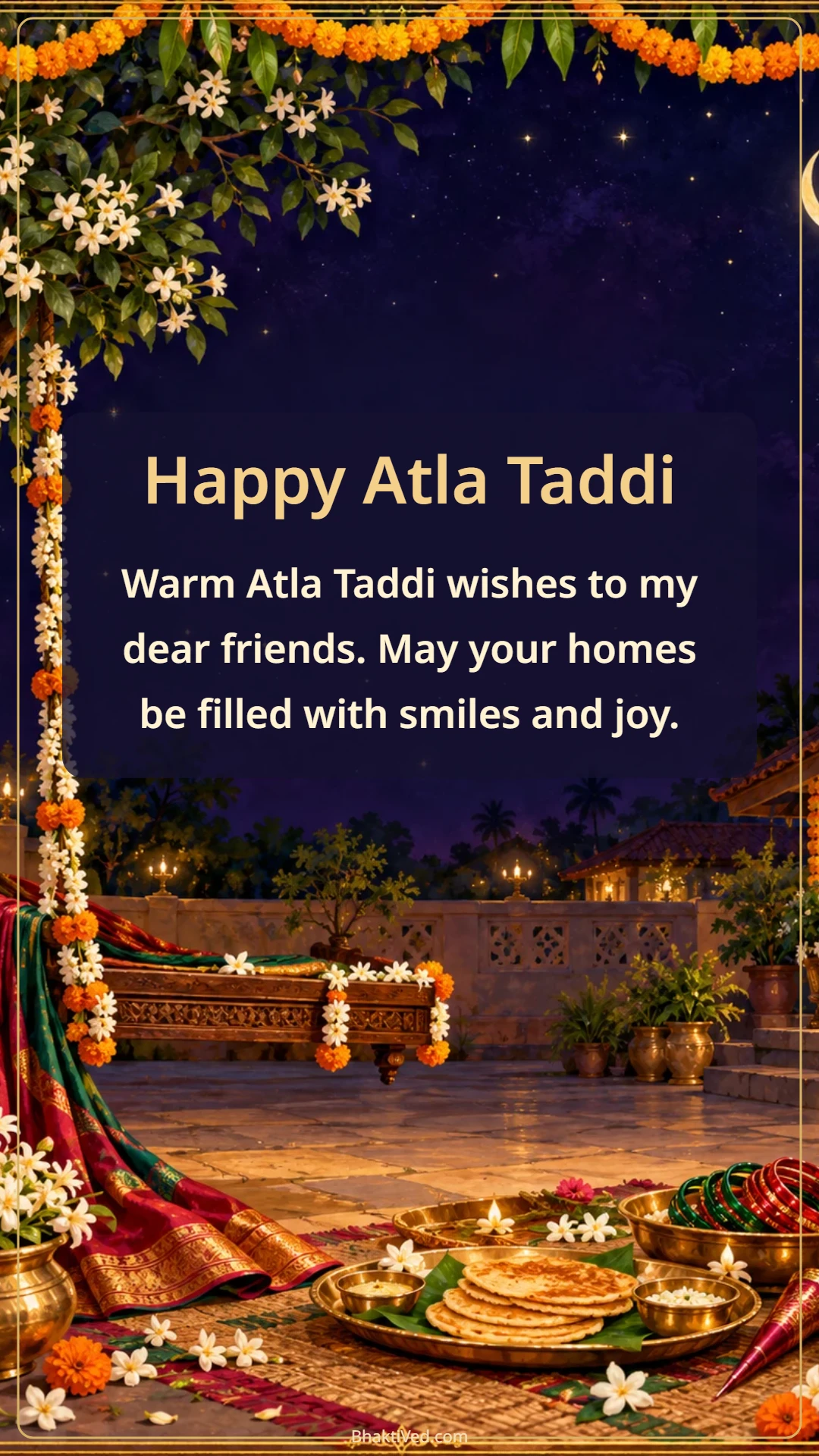
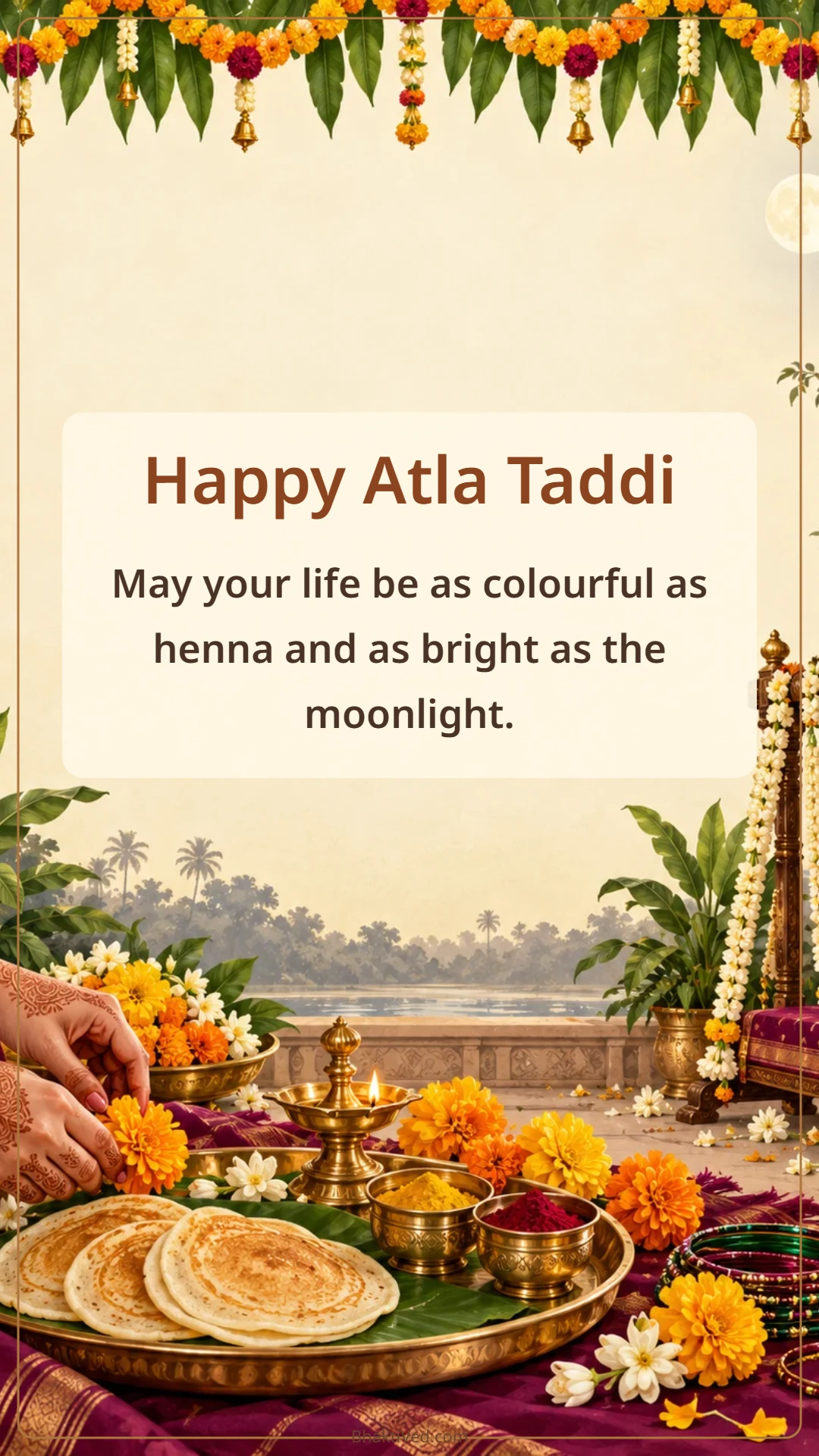
Choose for the person receiving it. General wishes suit anyone; traditional marital blessings are an optional choice for those who welcome them. These are original greetings, not mantras or scriptural quotations.
For everyone (3)
Happy Atla Taddi! Wishing you a peaceful day, a happy home and warmth in every connection.
May this Atla Taddi bring little joys, kind conversations and memories worth keeping.
Warm Atla Taddi wishes. Wherever you are, may you feel connected to the people who care about you.
For family (3)
Happy Atla Taddi to our whole family! Here’s to more shared laughter, thoughtful moments and time together.
To our family, close at heart even when far apart: happy Atla Taddi, with love to each of you.
May Atla Taddi add another happy memory to our family story, with affection from elders and laughter from children.
For parents and elders (3)
Happy Atla Taddi, Mum and Dad. Thank you for your love and for helping us discover our family traditions.
Respectful Atla Taddi wishes to our elders. Your stories and memories make the celebration special.
Happy Atla Taddi to our grandmothers! Time spent listening to your festival stories is a gift we treasure.
For friends (3)
Happy Atla Taddi, dear friends! Here’s to sharing a smile and making another good memory.
May your Atla Taddi be as joyful as a swing ride and as colourful as henna. Sending warm wishes, my friend!
Even if we cannot celebrate together, this Atla Taddi greeting is especially for you. Stay happy; let’s catch up soon!
For children (3)
Happy Atla Taddi, little ones! Enjoy the colours, sing a song and make happy memories with your family.
May Atla Taddi bring new stories, fun games and plenty of smiles. Sending love to all our young celebrants!
Learn a song, draw a picture and brighten the house with your smile. Happy Atla Taddi!
For a partner (3)
The little moments we share feel like a celebration. Here’s to our friendship and mutual respect. Happy Atla Taddi!
With love on Atla Taddi. May we keep sharing responsibilities, making time for one another and enjoying life together.
Happy Atla Taddi to my partner. May we keep supporting each other’s dreams and finding joy in our companionship.
Traditional blessings (3)
May Gauri Devi bless your home with peace, your partnership with affection and your family with happiness. Happy Atla Taddi.
Warm wishes to those observing Atla Taddi nomu. May Gauri Devi’s blessings bring you a peaceful festival.
As atlu are offered to Gauri, may gratitude grow in our hearts and kindness in our homes. Happy Atla Taddi.
Henna, swings and smiles with loved ones — happy Atla Taddi!
Peace to your home and joy to your heart this Atla Taddi.
Atla Taddi at a glance
2026 date
Wednesday, 28 October 2026
Lunar day
Ashwayuja Bahula Tadiya (Krishna Tritiya)
Deity
Gauri / Parvati
Main regions
Andhra Pradesh, Telangana and Telugu families elsewhere
Distinctive traditions
Atlu, henna, swings and Gauri puja
Atla Taddi is a Telugu festival observed in Andhra Pradesh and Telangana on Ashwayuja Bahula Tadiya. Gauri puja, gorintaku (henna), swings and atlu (dosas) are part of its traditions. Customs vary by family.
Choose the first video for the story and the second for a puja explanation. Both are in Telugu; the written guide is available in Telugu, Hindi and English.
Atla Taddi Vrata Katha in Telugu
A Telugu narration for visitors who want to listen to the Atla Taddi nomu story.
SWARNA'S SWEET HOME · 5:35 · తెలుగు
Ramaa Raavi: Atla Taddi Puja Vidhanam
Ramaa Raavi explains the Atla Taddi puja. Consider the explanation alongside your own household’s tradition.
SumanTV Omkaram · 10:10 · తెలుగు
Household customs may differ from those described in a video. Use this page’s 2026 date information and your local panchang for timing. Videos do not autoplay.
How do I send an image?
Choose “Share image” below a card, then select WhatsApp or another app in your phone’s share menu. If image sharing is unavailable, save the image and attach it in your chat.
Explore the festival guide
What is Atla Taddi?
Atla Taddi brings devotion, play and family connection together in Telugu households. Atlu means dosas, while taddi or tadiya refers to the third lunar day. It is observed on the third tithi of the waning fortnight after Ashwayuja Purnima. Atla Tadde and Atla Thaddi are alternate English spellings of the same festival.
In the vratam tradition, women pray to Gauri for saubhagyam and their loved ones’ wellbeing. Learning about the day or sending a greeting does not require keeping a vow. A newcomer can join the cultural celebration by spending time with family and asking about the customs that matter to them.
Atla Taddi 2026 date and puja timing
Atla Taddi falls on Wednesday, 28 October in 2026. Because the observance follows the lunar calendar, its Gregorian date changes from year to year.
Many households worship Gauri in the evening and complete their fast after moon sighting. Moonrise, the end of the tithi and a household’s puja time are different things. There is no single moonrise time for every visitor. Use a panchang set to your city; families abroad should not simply reuse an Indian clock time.
Why Atla Taddi matters
Devotion to Gauri is the spiritual centre of the day, with marital wellbeing forming part of its traditional prayers. Shared cooking, women’s companionship and memories passed on by elders can give the occasion a personal meaning too. Blessings are expressions of faith, not guarantees that a ritual will produce a particular life outcome.
Swings and folk songs reflect the festival’s playful side, also described in research on village customs. For a family celebrating today, a useful focus is the attention given to one another rather than the size or expense of the arrangements.
Atla Taddi Vrata Katha: story summary
Families tell different versions of the Atla Taddi nomu katha. Some centre on Gauri’s devotion to Shiva; others concern a young woman, moon sighting and the completion of a vow. These are devotional folk narratives rather than verified historical accounts.
In one familiar version, a young woman becomes weak while fasting. Her brothers show her an artificial light as the moon so that she will eat. Later, learning that the observance was incomplete, she follows Gauri’s guidance and undertakes it again. Names and endings vary between retellings. The story should not be used to blame anyone for illness or family difficulties.
When sharing a story with children, discuss honesty, care and the purpose of family traditions without turning its difficulties into threats about their future. For the full ritual recitation, use the nomu book followed in your household or an elder’s guidance. This short introduction is not a substitute for that liturgical text.
The following is a practical preparation checklist, not a universal puja prescription. Follow your family’s tradition for sankalpam, mantras, vayanam and the conclusion of a vow. A meaningful gathering does not require new decorations or buying every possible item.
Plan together: agree on guests, the customs being followed and the meal arrangements. Check the local panchang.
Prepare the space: clean the prayer area and gather the puja items, dosa batter and utensils you already have.
Enjoy the day: offer optional henna, songs or a safely supervised swing, and invite elders to share memories.
Gather for the evening: follow the household’s Gauri puja, offering, story or aarti. Keep an adult responsible for lamps.
Share thoughtfully: follow your own vayanam custom where applicable, and offer food and greetings with guests’ needs in mind.
Common preparations include the household’s image or form of Gauri, turmeric, kumkum, flowers, a lamp, water, fruit and atlu for the offering. Additional items such as akshata, betel leaves or areca nut depend on family practice. Check the list with an elder in advance to avoid last-minute pressure.
Vayanam is the sharing of food and customary gifts connected with the vow. In some families, atlu, fruit, turmeric and kumkum are offered to married women. Counts, recipients and gifts vary. Do not treat a number found online as a universal requirement for every home.
Atlu and festival food
Atlu are the food that gives the festival its name: small dosas prepared for the offering and shared according to household custom. Batter, flavour and size can differ. Some traditions include a pre-dawn meal of rice, curd and gongura chutney; that is not a compulsory menu for every family.
For an easy home preparation, use a dosa batter your household already knows. Make small portions on a hot pan, cook them through and set aside the offering as your tradition requires. This is a practical kitchen suggestion, not a rule prescribing a ritual batter. Let guests know which ingredients are in the dishes you serve.
Making the day welcoming for every age
Children can draw a rangoli, make paper flowers or learn a song from an elder, with adult supervision for swings. Let them explore the tradition without pressure to skip food or water. Young people can record family memories or arrange a video call with relatives who live far away.
Make room for elders to sit comfortably and tell their stories. People who do not fast, live alone or have lost a partner deserve warm greetings too. For a mixed group, choose peace, wellbeing and friendship rather than making assumptions about marriage or children.
Share preparation, cooking and tidying so the celebration does not become one person’s burden. Keeping a vow is a personal decision, not a reason to judge another household. Explain the customs gently to a guest experiencing them for the first time.
How to choose an appropriate greeting
Use a general wish for a family group or colleagues. Gratitude suits elders, playful joy suits children and warmth suits friends. Save marital blessings for someone who welcomes that sentiment. One personal sentence can make a card feel more thoughtful than a long forwarded message.
Copy a message below or choose “Make a card with this”. Select the card language, then adjust the name and wording. Before sharing, check the spelling and readability. Ask permission before using somebody else’s photograph.
Frequently asked questions
When is Atla Taddi in 2026?
Wednesday, 28 October 2026. Check a local panchang for the timing of your own observance.
Is Atla Taddi the same as Karwa Chauth?
No. They share themes such as moon sighting and marital wellbeing, but Atla Taddi is a Telugu Tritiya observance and Karwa Chauth a Chaturthi observance, with distinct food and customs.
Can unmarried people take part?
Unmarried women also traditionally participate in Gauri worship. Others can join the family gathering, food, songs and greetings. Respect should not depend on marital status.
Can I celebrate without fasting?
You can take part in a family celebration by spending time together, listening to stories, sharing food and sending wishes. Ask about your household’s practice if you wish to undertake a specific vow.
How many atlu should be offered?
Counts vary by tradition. Ask an elder about the number used for your household’s nomu and vayanam rather than assuming one online number is compulsory.
What can children do?
Try rangoli, flower decorations, songs, a supervised swing or stories with elders. There is no need to pressure them into fasting or expensive preparations.
How do I wish someone in Telugu?
Say “అట్లతద్ది శుభాకాంక్షలు” — Atla Taddi shubhakankshalu, meaning Atla Taddi greetings. Choose a suitable message from the relationship groups on this page.
Do I need to pay or sign in to make a card?
No. Ready images and personalized cards are free, with no login. Your selected photograph stays on your device.
What if the image does not share directly to WhatsApp?
Save the image and attach it as a photo in a WhatsApp chat or Status. Direct file sharing depends on your device and browser.
 BhaktiVed